
FAQs
The Project

We will NEVER charge you for a rabies vaccination during our vaccination campaigns. The vaccine is 100% free. If you think you have been wrongly charged for one of our vaccines, please get in contact on our free hotline number 3434 or on our Facebook page: Mission Rabies Malawi.
The vaccine we use is only for use in animals. Comprehensive rabies vaccination of the reservoir dog population has been proven to eliminate rabies and save human lives.
If you want to discuss human rabies vaccination, we suggest getting in contact with your local health department for more information.
Please make arrangements with other members of your family or neighbours to allow your dog to be vaccinated. Where possible, keep your dog confined to your compound, yard or on a lead for the day before and day after our teams are scheduled to be in your area. For residents of Blantyre, free rabies vaccine is also available through the WVS Malawi/BSCPA clinic all year round.
Smart phone technology! Our vaccination strategy is planned by targeting identified rabies hotspots in each district. With this information, each of the districts has been further divided into targeted working zones which vaccination teams will be working systematically throughout during your district's campaign. The vaccination team then log every dog vaccine using our bespoke mobile phone application which allows us to monitor and assess their progress. Once a team has reported their working region as complete, we can also send in our post-vaccination surveyors to estimate the percentage of the population which is vaccinated. If that number comes back as above 70%, we tick that district off as complete until next year. This means that we do not rely on costly or time-consuming methods of individual dog identification.
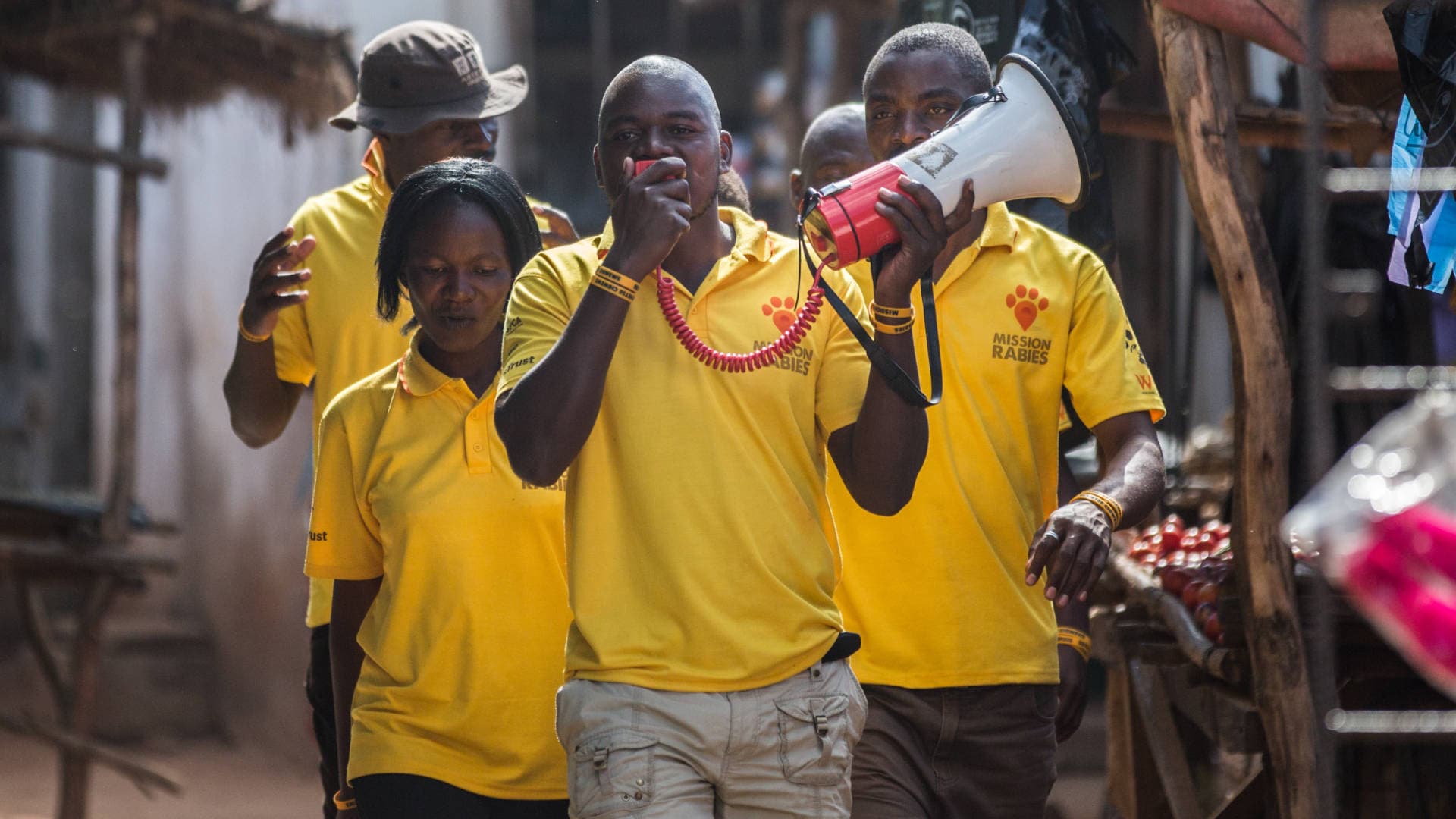
All vaccination team members are identifiable by our yellow Mission Rabies t-shirts.
Rabies Vaccination
Please listen for our announcements through your local community-based organisations, local leaders, churches, radio, and check any shared vaccination schedules to see when our teams will be in your area. You may also receive a text message ahead of our city campaigns.
Then make sure either you, a family member or a neighbour is available to give permission to our teams to vaccinate your dog. If your dog is normally free-roaming, please try to confine in a compound, yard or on a chain for the day we are scheduled to visit your area. If you are keeping your dog on a chain, please always make sure your dog has access to shelter and water at all times to avoid it suffering in the sun or rain.
Our vaccination teams rely on owners holding their own animals for vaccination. If your dog isn't used to being handled, please take this opportunity in the lead up to the vaccination campaign to get your dog used to human company more. Some treats and gentle pats are a nice start, working your way up to holding for a few seconds and walking on a lead. Our vaccination team can advise you on the safest ways to restrain your dog for vaccination.
Our experienced vaccination team members will be able to discuss this with you on a case-by-case basis. But as a general guideline, a dog with a physical injury which is being treated (e.g. a dog fight wound, lameness or transmissible venereal tumour (TVT)) can still be vaccinated. However, a dog which is very ill with for example a severe skin condition, who has been vomiting, had diarrhoea or is very thin may not be a good candidate for vaccination.
If your dog is injured or ill, we recommend taking them to your local veterinary office for treatment.
Rabies vaccination needs to be repeated once every year to ensure that herd immunity is maintained in the whole dog population in your area. As a general rule, if your dog has been vaccinated within 6 months of our vaccination campaign, it will not need a booster. Any time longer than that, our teams will be happy to vaccinate your dog again for free.
As rabies is endemic in Malawi we recommend vaccinating puppies of all ages. We follow the information in the data sheet for the vaccine we use, Nobivac Rabies (MSD Animal Health) which states that the recommended primary vaccination age is 3 months however 'Primary vaccination can be administered at an earlier age, but then a repeat vaccination must be given at the age of 3 or 6 months depending on the species'
The manufacturer of the rabies vaccine reports that the vaccine can be safely used in pregnant or lactating animals.
Our teams are using animal-friendly paint to mark vaccinated dogs. This will last for a few days and act as an indicator for our post-vaccination survey teams. All owners of vaccinated dogs over the age of 3 months will also receive a vaccination slip.
We need to vaccinate dogs against rabies every year, including those that have been vaccinated in previous campaigns. Smart phone technology is used to map out the whole of the vaccination area. Teams are directed systematically from region to region, ensuring efficient coverage of target regions. After a team has reported that their region is complete, post-vaccination survey teams are can be sent into the region to estimate whether over 70% of the population has been vaccinated. If over 70% has been achieved, this region will be ticked off and teams will move to the next region. We can also estimate whether an area is sufficiently covered based on our estimated number of dogs in that area from previous years.
With such a high annual dog turnover of the dog population, our method relies on looking at dogs as a 'herd' rather than individuals. As such, this technology-based method is the more efficient to protect communities form rabies.
This vaccination campaign is only delivering rabies vaccinations. Please contact your local government animal health department or local charity for other vaccinations for your dog.
Please contact your local government animal health department or local charity for further advice on rabies vaccinations for your dog.
Please contact your local government animal health department or local charity for further advice on rabies vaccinations for your dog.
So that we can protect as many communities in Malawi as possible during our campaign, we are focusing only on rabies vaccination.
However, in Blantyre, WVS Malawi/Blantyre Society for the Protection and Care of Animals (BSPCA) clinic provides sterilisation services and at times local outreach clinics.
Rabies
Rabies is a virus that is transmitted through animals that have mammary glands (mammals). The rabies virus attacks animals that suckle their young with milk (mammals only). Once it enters the body, it attaches to a nerve, multiplies, and travels through the central nervous system up to the brain.
The first symptoms of rabies are often very vague (headaches, high temperature, depression, flu-like symptoms), and it can be easy to mistake them for other types of infection. Once the virus reaches the brain, the fatal symptoms start, and by then it is too late, and there is no cure.
There are two types of rabies:
• Furious rabies – aggressive behaviours, including thrashing and biting, hallucinations and delusions, very high temperature and sweating, hydrophobia, excessive salivation, and insomnia.
• Paralytic rabies – muscle weakness, loss of sensation, and paralysis.
Rabies is always fatal, but it is 100% preventable. When the virus enters the brain and the fatal symptoms start showing, it will lead to the person falling into a coma and eventually dying from heart or lung failure.
Rabies is transmitted through the saliva of an infected animal, and can be transferred to humans through:
i. Biting
ii. Licking – saliva on open wounds
iii. Scratching – anything that causes the skin to become red and raised.
It is very important to follow these first aid steps if you are exposed to an animal (bite, scratch, saliva in the eyes, nose, or mouth, lick on a wound or any broken part of your body):
1) Wash the wound with soap and running water for 15 minutes.
2) Apply an antiseptic (Dettol, iodine, methylated spirit). DO NOT cover the wound. If the wound is covered, it is more likely to get infected.
3) Report the dog to the closest government veterinary office, where they shall verify if the dog is vaccinated.
4) Go to the hospital for medical attention. If the hospital has prescribed a rabies post-exposure vaccination, you must remember to take the full course.
Rabies is much harder to diagnose in animals. The only way to know for sure if a dog has rabies is by taking a brain sample after its death.
An animal that is ill with rabies may show:
• Furious symptoms – unusual restlessness, snapping at invisible objects, aimless running, biting, excessive salivation, unprovoked aggressiveness, uncoordinated movements, and paralysis.
• Paralytic symptoms – profuse salivation, dropping of the lower jaw, inability to swallow.
Do not approach the animal, do not try to restrain it, or try to harm it. This is very dangerous. Call 3434, our free Rabies Hotline number, immediately, and one of our staff members will discuss the symptoms and possibly come out and assess the dog. Make sure you remember their location, what they look like, and their behaviour.
Yes, dogs communicate. We just need to learn their language so that we are able to understand them. We can also communicate with them, and they will also be able to understand us.
• Happy or calm dog – when a dog is wagging its tail or has its mouth open (with no teeth showing), it is telling you that it is happy or it is calm.
• Nervous dog – when a dog has its tail between its legs, its ears are pressed flat against the side of the head or it is cowering low to the ground, it is nervous.
• Angry dog - when a dog is showing its teeth or growling and the hairs on its back are raised, it is angry.
Do not approach angry or nervous dogs.
We should treat dogs with respect and give them space.
To keep dogs calm and reduce the risk of getting bitten, remember the following:
- Stay calm and quiet. Loud noises can scare dogs.
- Move slowly. Avoid running, cycling or making sudden movements around dogs.
- Look for body language but don’t stare. Eye contact can be threatening to a dog.
- Leave dogs alone when they are eating, sleeping or with puppies. Dogs might become angry if they are
disturbed when eating, sleeping or protecting their puppies.
- Be respectful and kind.
Remember to stay calm - Do not scream or run!
• IF the dog is far away, THEN… move slowly to safety.
• IF the dog is moving towards you, THEN… create height or a barrier to shield yourself. Call for help. You could stand on a wall, get behind a closed door or gate in a safe space or use a backpack as a barrier.
• IF the dog is up close, THEN… stay still and stand like a tree. Cross your arms across your chest, stay still and don’t make eye contact with the dog.
• IF the dog knocks you to the ground, THEN… curl up like a rock.
Always protect your head and neck using your arms. It is better for a dog to bite you on your arms than to bite you on the head. If the dog is able to push you onto the ground or if you fall, keep protecting your head and neck and form a ball with your body to protect yourself.
Children should not fear dogs, especially if the dogs are friendly and relaxed. It is important that children wait for a dog to approach them, without running. If they have a relaxed posture and are wagging their tail, they can be petted gently.
Aggression is part of any animal’s communication, including humans. You only need to be cautious of a dog if it is growling, has a tense posture, and bared teeth, as they are warning you that they are scared or angry and that they might bite.
Dogs can spread this disease from one dog to another within the dog population as well as to humans and other mammals. Dogs are responsible for 99% of rabies cases in humans because of their proximity and relationship to humans. It is important to remember that not all dogs have rabies, but all dog bites should be taken seriously and treated as a potential rabies exposure unless you know the dog received a rabies vaccination within the past twelve months (one year). For any bite that takes place, including one from a vaccinated dog, the victim must still receive the dog bite first aid before seeking medical attention.
Vaccinating humans is very costly. Already vaccinated people are still not 100% protected from rabies and would need to get two vaccinations after exposure to a rabid animal. Vaccinating dogs is the quickest and fastest way to protect people and to stop the virus at the source. A dog only requires one vaccine, and it is protected for an entire year.
The World Health Organisation (WHO) recommends vaccinating 70% of the dog population. This makes it more difficult for the rabies virus to spread to dogs that have not been vaccinated in an area.
This vaccine is safe for dogs of all ages, as well as pregnant females. The vaccine we use is an internationally recognised brand (MSD Animal Health), which has been widely tested for safety. The risk of side effects is very low. Although this vaccine protects dogs against rabies, it does not protect dogs from other diseases or illnesses that could cause death.
The anti-rabies vaccine is given annually at a very nominal cost. You can visit a veterinary Officer, a private veterinarian, or an animal welfare NGO for the annual vaccination. Mission Rabies administers free rabies vaccine.
Contact your local animal health officer and our free rabies hotline on 3434. If your dog was previously vaccinated against rabies, you should ensure that your dog receives a further rabies booster vaccination. You should then keep your dog contains to avoid mixing with other dogs and monitor them closely for the next 60 days. You can this discuss these measures with our hotline operators. If they start showing any signs of rabies, contact your local animal health officer or our free rabies hotline number 3434 for advice.
Education is incredibly important to save people's lives. Please get in touch with our education manager through malawi@missionrabies.com to discuss how we can help you spread the message about rabies prevention.
We also have a lot of educational materials; you can find some of these on our Rabies Resources page.
Working with us
Please get in touch with our team by email (malawi@missionrabies.com) to discuss your project.
The Future
We hope that the success of this scaled-up project will create a blueprint for the rest of Malawi. Watch this space.